
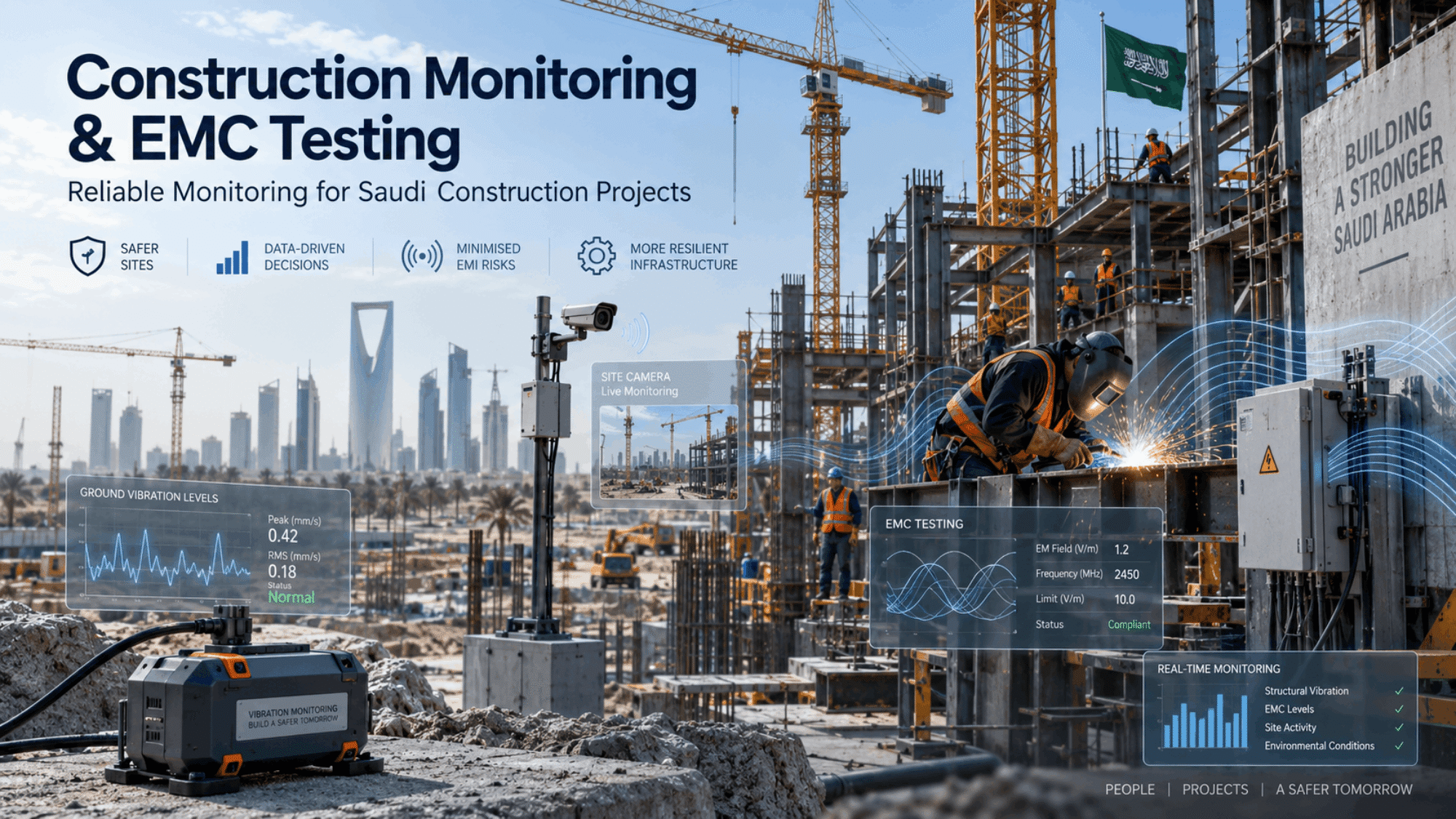
Imagine a construction site that is active. Cranes swing overhead. Welders spark steel beams. The vibrations are monitored with sensors deep into the ground. The progress is registered every minute using cameras. Suppose however that one of those surveillance apparatuses were faulty, not through wear and tear, but through unseen electromagnetic interference.
That’s the point when Electromagnetic Compatibility (EMC) testing comes in. It makes sure that the technology applied in construction monitoring services remains reliable, accurate and safe. In its absence the tools we are relying on may provide misleading results, slow down projects, or expose individuals to danger.
What Is EMC Testing?
All electronics including phones, welding machines, cranes, and even ground shaking devices, release a small emission of electromagnetic field. In case these areas interfere with one another, the systems may malfunction.
EMC tests the ability of equipment to work in the real-world, and not to either generate or be affected by interference. Imagine a referee to ensure that all are playing in the same field without bias.
In construction, where the heavy equipment, sensors and monitoring systems operate simultaneously, EMC compliance is essential. It is the distinction between a smooth sailing and an expensive complication.
Ensuring Your Product Will Pass EMC
The world has regulatory bodies that require adherence to the EMC standards. This is not just a red tape, it is genuinely concerned with safety.
To illustrate, a construction monitoring system will be tracking cracks in a bridge or the stability of the structure of a tower. When such readings are disrupted by interference, then engineers may not notice warning indicators. That results in delays, damage, or worse.
To comply with EMC requirements, it is important to test earlier in the design phase, validate with EMC testing labs as well as certification. Those companies that do so will not experience downtime, stay safe, and gain trust.
EMC Contribution to Construction Monitoring Projects
So, What is construction monitoring then? It involves monitoring safety, quality and progress within a building site. Monitoring of these levels of vibration in nearby structures as well as crane and welding inspection calibration makes every movement as intended.
However, when the monitoring tools are not EMC checked, it may give faulty readings. The sensor would lie on the vibration levels. A progress camera might lose information. False measurements could be provided by a calibration device.
That is why not to make EMC testing optional. It is one of the supports of sound construction project monitoring.
Inside EMC Testing Labs
How do we find out that equipment comes through the test?
That is what EMC testing labs are meant to do.
These labs subject equipment to artificial electromagnetic fields. They gauge emissions (what the device is emitting) and immunity (what the device is resisting). It is as though to put stress-test equipment on invisible energy waves.
Gripco relates these tests with inspections and audits in the real world. The presence of a team that has been trusted in terms of welding inspection, calibration and assessment of the vendor makes EMC testing to be a part of a broader safety net about projects.
Construction Monitoring Systems and EMC
Modern construction monitoring systems are complex. They integrate the sensors, cameras and the data loggers into single ecosystem. All the machines contribute to the measurement of safety and advances.
But complexity brings risk. An increase in devices increases opportunities of interference. A ground vibration sensor that is fitted on a crane motor may lose its precision. There may be loss of data in a wireless monitoring system.
EMC tests are used to make sure that these systems remain strong in case of pressure. It is the silent guard who keeps the construction sites out of the reach of noise of distraction.
Construction Monitoring Services: Why They Depend on EMC
The construction monitoring services are used by contractors and project managers to be informed. Monitoring systems provide progress reports, safety alerts, inspection data, and so on.
In case the data is inaccurate, so the decision is being made is wrong as well. This is the reason that EMC compliance is a requirement, as it enables the monitoring services to provide the right information, free of interference, to all stakeholders.
In the case of building construction monitoring, it is not only a matter of technical reliability, but fiscal. Delays cost money. Disputes can be aroused by faulty data and the threat of these risks is mitigated by EMC testing.
Construction Monitoring Tools and Ground Vibration Monitoring Equipment
Ground vibration monitoring equipment is one of the most sensitive ones in the category of all construction monitoring tools. These gadgets track the tiniest movement of the soil or other constructions. They are essential in the time when the heavy machinery is working near the already existing buildings.
However, even a little burst of electromagnetic noise due to welding or calibration of nearby devices may cause their readings to be altered. That is why the vibration monitors require EMC compliance.
The same applies in the case of calibration instruments that are involved in pressure and thermal testing. When their signals are off, whole systems might start to fly out of safety margins without anybody paying attention to it. EMC testing closes that gap.
How EMC fits into the Gripco’s Services
Gripco isn’t about a single examination. It is all about establishing a trust based on all inspections and analyses.
Since the time of metallurgical analysis up to welder qualification testing, from vendor inspection to calibration, all the services relate to the same mission, to provide safety, reliability, and compliance.
Our ecosystem is supplemented by EMC testing. It protects the tools in the background of the construction surveillance, which binds the electrical reliability with the physical integrity. The two of them are a complete circle solution to clients who are high-demand agencies.
The Future of EMC Construction Monitoring
Construction is evolving at rapid rates. IoT sensors are currently used to monitor real-time data. Smart technology monitors the impending risks. Drones survey sites daily.
The greater the amount of electronics results in moreelectromagnetic noise. The construction sites of the future will require even more EMC compliance than ever before.
Gripco practices a culture of progress monitoring and inspection of construction thus keeping clients ahead. With the increasing technology, there is the need to test the unseen forces that influence technology.
Conclusion
Construction is concerned with power and accuracy. Strength, however, is nothing without reliability. EMC testing ensures that the systems that ensure safety of projects are not sabotaged by the invisible forces of electromagnetism.
The EMC compliance is the glue holding all the construction sites monitoring to the ground vibration equipment, welding inspections up to the calibration.
The moral of the story is straight forward; EMC is not a sided test. It is the key of construction monitoring. At Gripco, safety is not a matter of chance but it is ensured by all checks and tests and projects.